
Montessori for Babies: What can parents do during their child’s first year?
When people hear “Montessori”, many first think of kindergarten or primary school – small wooden materials, calm classrooms, children concentrating on tasks of their own choosing. What few people realise, however, is that Montessori education begins from the very first breath. The first year of life in particular is a time when simple changes can make a real difference. Today, I want to show you what worked for us at home – without any pressure to make everything perfect, because Montessori in everyday life is not about doing everything one hundred percent “right”.
The Basic Principle: Trusting the Child
Maria Montessori believed that every child is born with an inner blueprint – a natural drive to develop independently when provided with the right environment. For babies, this means something very practical: we do not need to constantly “stimulate” or actively support their development. Instead, we should observe them and give them space. For me, this was the biggest adjustment at the beginning. As parents, we naturally want to show, explain and encourage so much – while a baby often simply needs time and calm to discover something independently.
A Floor Bed Instead of a Cot
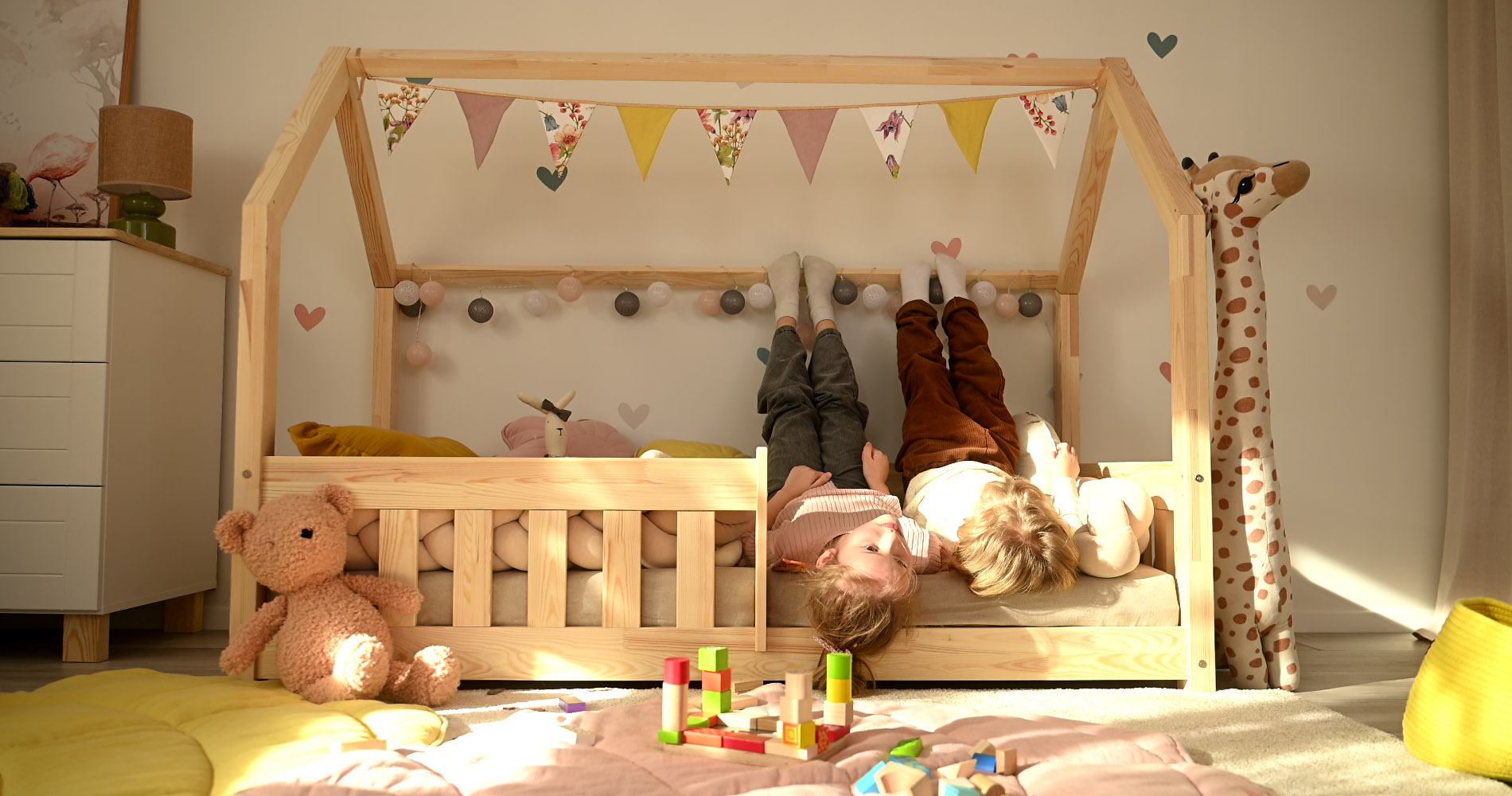
One of the best-known Montessori principles for babies is the Classic beds – a mattress placed directly on or close to the floor instead of inside a high-sided cot. The idea behind it is simple: once the baby becomes mobile, they can get in and out independently and are not restricted by cot bars. At first, we approached this idea with some caution – you naturally wonder whether the room is truly safe enough. But that is exactly the point: before introducing a floor bed, the entire room should be childproofed so that the baby can move around freely and safely.
You do not need to introduce a floor bed from day one. Switching later, for example when your baby begins to crawl or move around independently, is perfectly fine as well.
The Movement Area: Less Is More
Instead of relying constantly on infant carriers, baby bouncers and playpens, Montessori encourages creating a free movement area. A soft mat, a low mirror on the wall, a mobile or a single toy placed within easy reach are often more than enough. The idea is to allow the baby to kick, turn, reach and later crawl without being restricted in their natural movements by seats or straps.
With our children, we took a fairly practical approach: Mats in the living room, a mirror within easy reach and only one or two objects available at a time. This also had an unexpected benefit for us as parents – less clutter means less visual overstimulation, both for the baby and for us.
Open Shelves Instead of Toy Boxes
Another important principle is the way toys are presented. In a Montessori environment, everything is not simply thrown into one large box for the child to rummage through. Instead, individual objects are arranged clearly on a low, open shelf. The baby can immediately see what is available, gradually learn to make a conscious choice and, over time, learn to return objects to their place after playing.
For us, this mainly meant reducing the number of toys on display. Instead of offering ten toys at once, we rotate them – two or three objects remain available while the rest are stored away. As soon as interest begins to fade, we replace one of them. At first, it may seem like very little, but I was genuinely surprised by how much longer our children were able to concentrate as a result.
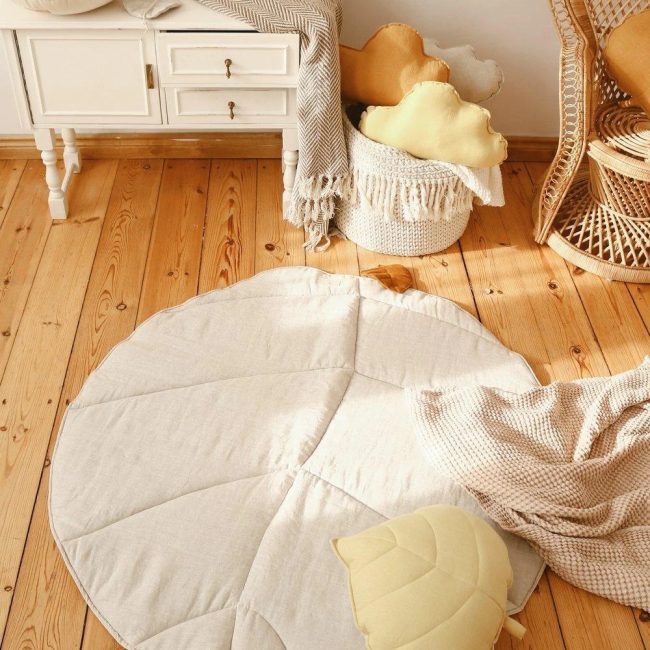
Leaf-shaped quilted linen mats

Bed bumper – Horse 230 cm
Modular Kids Furniture Set

Kids bed, Floor bed Vedo
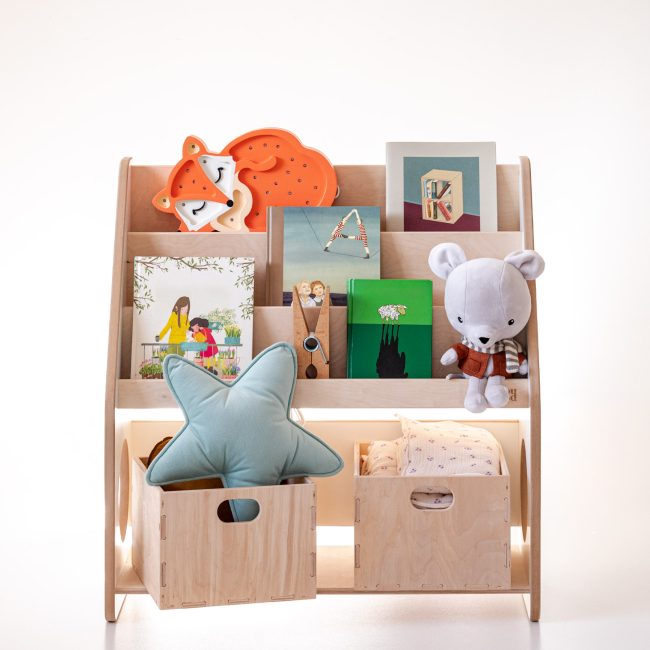
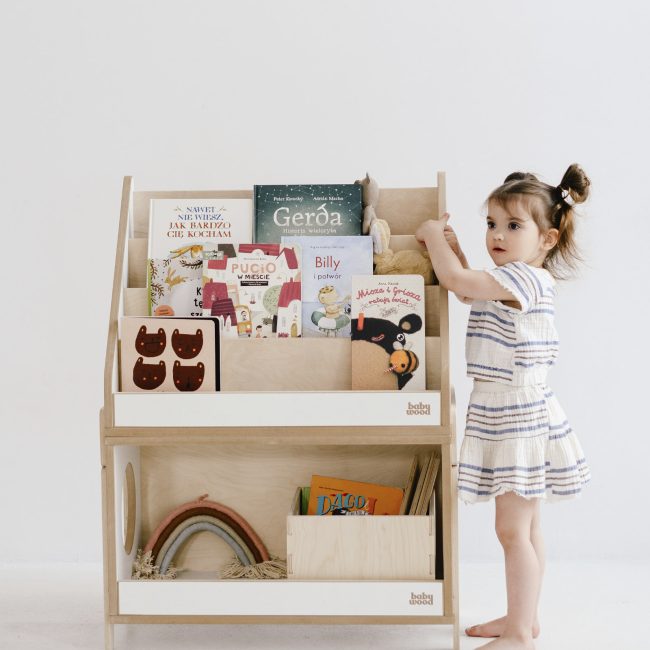
Montessori Wooden Bookcase
Independence at Mealtimes
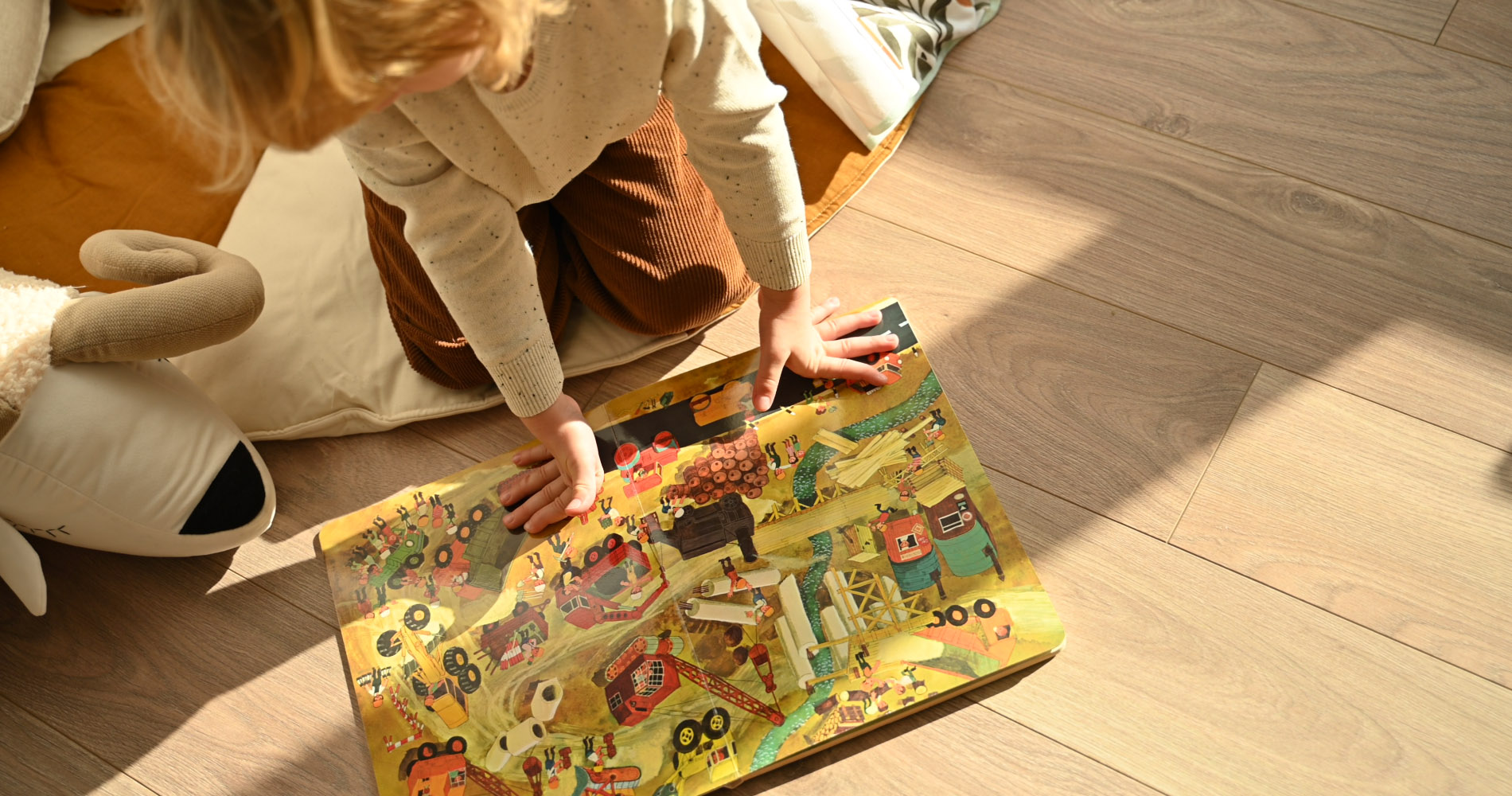
There are also Montessori-inspired ideas that can be introduced during meals in the first year. Once a baby can sit upright independently, they can sit at a small table with a suitably sized chair – at their own level, with their feet supported, rather than sitting high above everyone else in a traditional high chair. This can provide a sense of stability and also support motor development.
Baby-led weaning, where solid foods are introduced as finger foods rather than exclusively as purées, fits well with this general approach: the baby decides how much to eat and at what pace. We did not follow this method strictly – in our home, we used a combination of purées and finger foods – but the central idea of giving the baby as much independence as possible during meals worked very well for us.
Real Language Instead of Baby Talk
One idea that personally convinced me the most is the Montessori recommendation to speak to babies in complete, grammatically correct sentences from the very beginning – without baby talk, while still using a warm and calm tone. You simply explain what is happening: “I’m going to put your socks on now” instead of using simplified words such as “little foot, little foot”. It may feel unusual at first, but it supports language development and, at the same time, shows the child respect.
Observe Instead of Intervening
For me, perhaps the most important – and at the same time the most difficult – principle is conscious observation. When a baby is concentrating on experimenting with something, dropping an object and picking it up again, or spending several minutes simply looking at their own hands, our natural instinct is often to intervene, help or entertain them. The Montessori approach would suggest pausing for a moment and observing whether the child actually needs help – or whether they simply need some uninterrupted time to work things out independently.
This is not something anyone learns to do perfectly overnight. We also have days when everyday life moves faster than our patience allows. But that is exactly why Montessori during the first year is not about perfection. It is about a general attitude: trusting the child to do what they are already capable of doing and creating an environment that gives them the opportunity to demonstrate those abilities.
Montessori for babies does not mean buying expensive toys or completely redesigning the nursery. It begins with much smaller things: a tidy shelf, a little more patience while getting dressed, or simply talking to your baby with respect and attention. If you want to take just one idea from this article, I would recommend starting by reducing the number of toys available at any one time – it is one of the easiest Montessori principles to introduce, and the difference can often be noticeable almost immediately.

Angelina Zünd
My name is Angelina, I am 35 years old, a mom of two wonderful children, and I have been an elementary school teacher for over ten years with additional training in Montessori education. Alongside my work as a teacher, I am also a content creator and share ideas and inspiration on my Instagram account linas_gluecksmomente_ on how Montessori education can be implemented in everyday life at home. I truly love both roles and enjoy connecting my experiences from school with our family life.
Related Posts

What can be done to make a child want to sleep in their room?
Most parents, especially in the beginning, choose to sleep i

Spring freshness in the children’s room – 5 ideas inspired by nature and Montessori
When spring awakens, it’s a sign: time for fresh air, more

Montessori in everyday life – how to implement it realistically
Implementing Montessori in everyday life often sounds easier
Leave a Reply